Sector

AI for transport and logistics: orders, documents, claims

Who it is for
Hauliers, removal firms, logistics and distribution companies of 10 to 200 people: planning under pressure, many orders arriving by e-mail and paperwork with every shipment.
Software in use
Transport (TMS) and warehouse (WMS) software, ERP, shipper portals, Passar for customs, e-mail
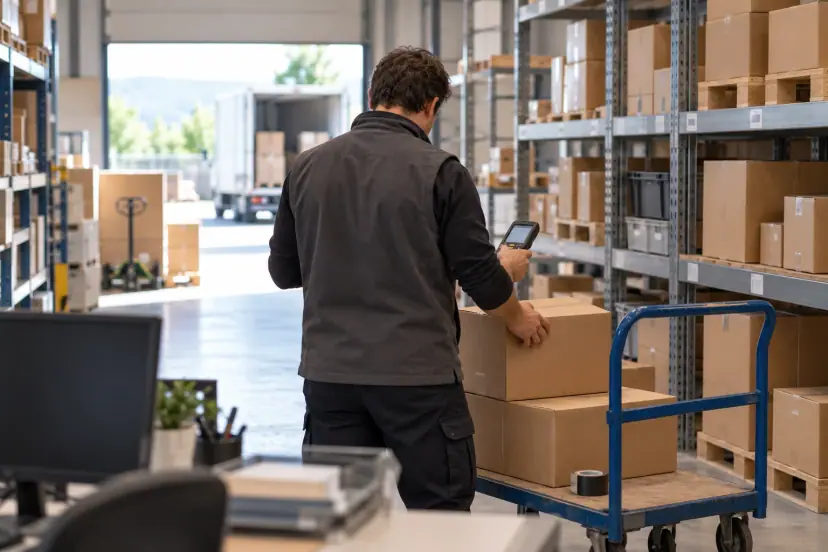
A warehouse worker seen from behind places a box on a trolley in a tidy warehouse, a scanning terminal in hand.

Direct answer

In transport and logistics, AI is useful where information arrives in a mess: orders received by e-mail or PDF to re-key into the TMS, shipping documents to check, damage and claims to document. Route planning stays in your tools; AI prepares the data, the dispatcher decides.

Orders received by e-mail

The assistant reads transport orders received by e-mail or PDF (addresses, dates, weights, pallets, conditions), puts them in your TMS import format and flags missing information. The dispatcher checks before confirming.

What we measure — Entry time per order and data-entry errors discovered at delivery.

Checking shipping documents

Delivery notes, consignment notes, commercial invoices for export: the assistant compares the documents with each other and with the order, and flags discrepancies (weights, quantities, missing tariff numbers) before departure.

What we measure — The number of shipments held up or corrected after departure.

Claims and damage

From the photos, the signed delivery note and the correspondence, the assistant drafts the claim file or the reply to the customer, with a timeline of events. The manager approves the company’s position.

What we measure — Time to handle a claim and the share of files complete on first submission.

Delivery data (addresses, recipients) falls under the nFADP, and your contracts with shippers often set confidentiality rules. The tools we select make it possible to comply if data is not used for training and access is limited to what is needed. Customs declarations remain your responsibility.

How much does it cost for an SME?

A half-day workshop on your own cases: from CHF 1,900 excl. VAT. To roll it out with your teams: a subscription from CHF 1,800/month (10 h), three months minimum, or a fixed-price engagement on quotation. Details are on the pricing page.

Do we need an AI manager?

No, not in an SME. What works: a contact point who validates usage, not a dedicated role.

Which tools for this line of business?

It depends on what you already use. The tools we most often recommend for this line of business are shown above; the final choice is made with your IT team, depending on whether you work in Microsoft 365 or Google Workspace.

AI Workshop, from CHF 1,900 excl. VAT: half a day on your own tasks.

You leave with the use cases chosen for your company, the right tool and the rules of use. Price confirmed before we start.